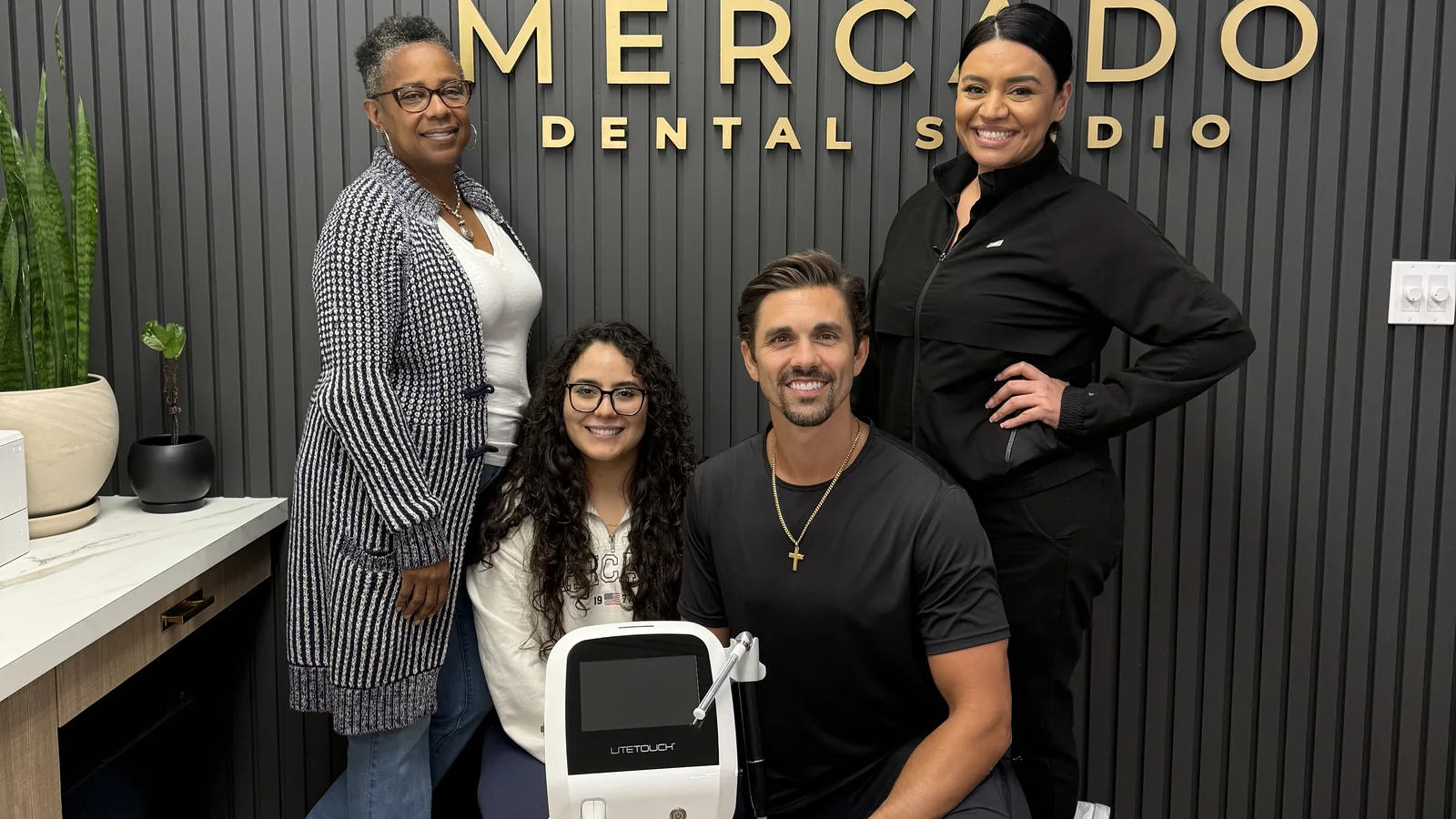
Mercado Dental Studio treats many cavities and gum procedures with the LiteTouch Er:YAG dental laser. No drill. No vibration. And for a large share of patients, no injection.
The two things people hate about the dentist are the needle and the drill.
Both of them are solvable. Dr. Mercado uses the LiteTouch Er:YAG dental laser, an all-tissue laser that removes decay and reshapes gum tissue using pulses of light energy instead of a spinning bur or a blade.
Because there is no friction, there is no heat pressure and no vibration, and those two sensations are what the nerve inside a tooth actually complains about during a conventional filling. Remove them and a great many patients simply do not need to be numbed. That is the practical headline. The rest of this page explains how it works, exactly what it is used for here, and where it is honestly not the right tool.
How an Er:YAG dental laser actually works
Er:YAG stands for erbium-doped yttrium aluminium garnet, the crystal that generates the beam. What matters clinically is the wavelength it produces: 2,940 nanometers, which happens to sit at the peak absorption point for water.
Enamel, dentin, decayed tooth structure, and gum tissue all contain water. When the laser fires a pulse, the water inside a microscopically thin layer of tissue absorbs that energy instantly, expands, and lifts that layer away. The process repeats thousands of times a second, removing tissue in layers finer than a bur can cut, while a cooling water spray runs continuously across the tooth.
Two consequences follow. First, there is no mechanical contact, so no vibration travels down into the pulp and no smear layer is packed into the tooth surface. Second, the energy is spent almost entirely on the tissue with the highest water content, which is decayed tooth structure. Healthy enamel is denser and more mineralized, so it resists the laser more than soft, wet decay does. In practice the instrument is naturally biased toward the part you want gone, which is the core of what minimally invasive dentistry is trying to achieve.
The LiteTouch system carries the laser inside the handpiece itself rather than piping the beam through a fiber or an articulated arm. For the patient, that translates into a lighter, more precise instrument in the mouth and a device that looks and handles more like a normal dental handpiece than a piece of hospital equipment.
What Dr. Mercado uses the laser for
The LiteTouch is cleared by the FDA as an all-tissue laser, which means it is authorized for both hard tissue and soft tissue procedures. Dr. Mercado uses it in two areas of the practice.
This is the reason most people search for a laser dentist in the first place, so it is worth being precise about it.
A conventional filling is uncomfortable for two reasons that have nothing to do with the cavity itself. A rotary handpiece spins against the tooth at very high speed, which generates frictional heat and transmits vibration straight into the nerve. Anesthetic exists largely to block the response to those two inputs. Take away the friction and the vibration, and the input the nerve was reacting to is mostly gone.
So Dr. Mercado starts many restorative appointments without anesthetic. You sit up, you are asked how it feels after the first few seconds, and the appointment continues that way if you are comfortable. Patients frequently finish a filling, walk out with full sensation in their lip and tongue, and eat lunch normally an hour later.
It is not universal. Decay that has reached close to the pulp, a tooth that is already inflamed and sensitized, and larger or deeper preparations can all still warrant local anesthetic. Comfort thresholds also differ enormously from person to person. The working agreement here is simple: we start without the injection when the case allows it, you say the word at any point, and you get numbed immediately without being asked to justify it.
Gum work without a scalpel
The same wavelength that removes decay also cuts soft tissue, and this is where the laser quietly earns its keep in cosmetic cases.
A beautiful veneer case is not only about the porcelain. If the gum line runs unevenly across the front teeth, or sits low enough to make otherwise well-proportioned teeth look short, the finished smile reads as slightly off even when the ceramics are flawless. Reshaping that gum line with a laser lets Dr. Mercado sculpt the tissue in very small increments while checking symmetry against the tooth proportions he is designing to.
Compared with a blade, laser soft tissue work is generally less bloody, because the laser seals small vessels as it goes, which also means a clearer field to work in and, for many patients, a quieter recovery with no sutures. Because the energy is absorbed within a thin layer, the shaping is precise rather than approximate.
Laser gum recontouring is often performed alongside veneers, bonding, or a full smile makeover, and in those cases it is planned as part of the cosmetic design rather than treated as a separate event.
What a laser appointment is actually like
Exam and plan. Dr. Mercado looks at the tooth, the radiographs, and the depth of the decay, then tells you plainly whether the laser is a good fit and whether he expects you will want anesthetic.
Eyewear. You, Dr. Mercado, and the assistant all put on protective eyewear matched to the wavelength. This is standard for every laser appointment.
Treatment begins. You hear a rhythmic popping and feel a cool water mist. There is no whine, no vibration, and no pressure pushing against the tooth. Most patients report it is the sound and the water they notice, not sensation in the tooth.
You stay in control. Raise a hand and everything stops. If you want to be numbed, you are numbed, and the rest of the visit continues conventionally.
The restoration. Once decay is removed, the tooth is bonded and filled with tooth-colored composite, shaped, and polished exactly as it would be otherwise.
Afterward. With no anesthetic there is nothing to wear off, so you leave with normal sensation and can usually eat right away. Sensitivity for a day or two is possible with any new filling.
Where the laser is not the right tool
The laser is one instrument among several, and using it well means knowing when to reach for a different one.
Existing metal work. The laser does not cut metal. Old amalgam fillings, metal crowns, and posts are removed with conventional instruments.
Some crown and bridge preparation. Full-coverage preparations that need very specific margins and taper are often shaped faster and more predictably with a handpiece.
Deep or inflamed teeth. When decay is close to the nerve or the pulp is already irritated, anesthetic is the right call regardless of the instrument.
Access. Some surfaces between back teeth are simply easier to reach and shape conventionally.
Time. Laser preparation can take somewhat longer than a bur on larger restorations. Most patients consider that a fair trade for skipping the injection. Some do not, and that is a legitimate preference.
Dr. Mercado picks the instrument that suits the tooth, and tells you which one he plans to use before he starts.
The equipment, specifically
The studio uses the LiteTouch Er:YAG dental laser from Light Instruments. It is a 2,940 nm erbium laser cleared by the FDA for dental hard tissue procedures including caries removal, cavity preparation, and enamel etching, and for soft tissue procedures including gingivectomy, frenectomy, and the exposure of unerupted teeth. Its distinguishing engineering feature is that the laser source sits inside the handpiece rather than being routed through a fiber or mirrored arm.
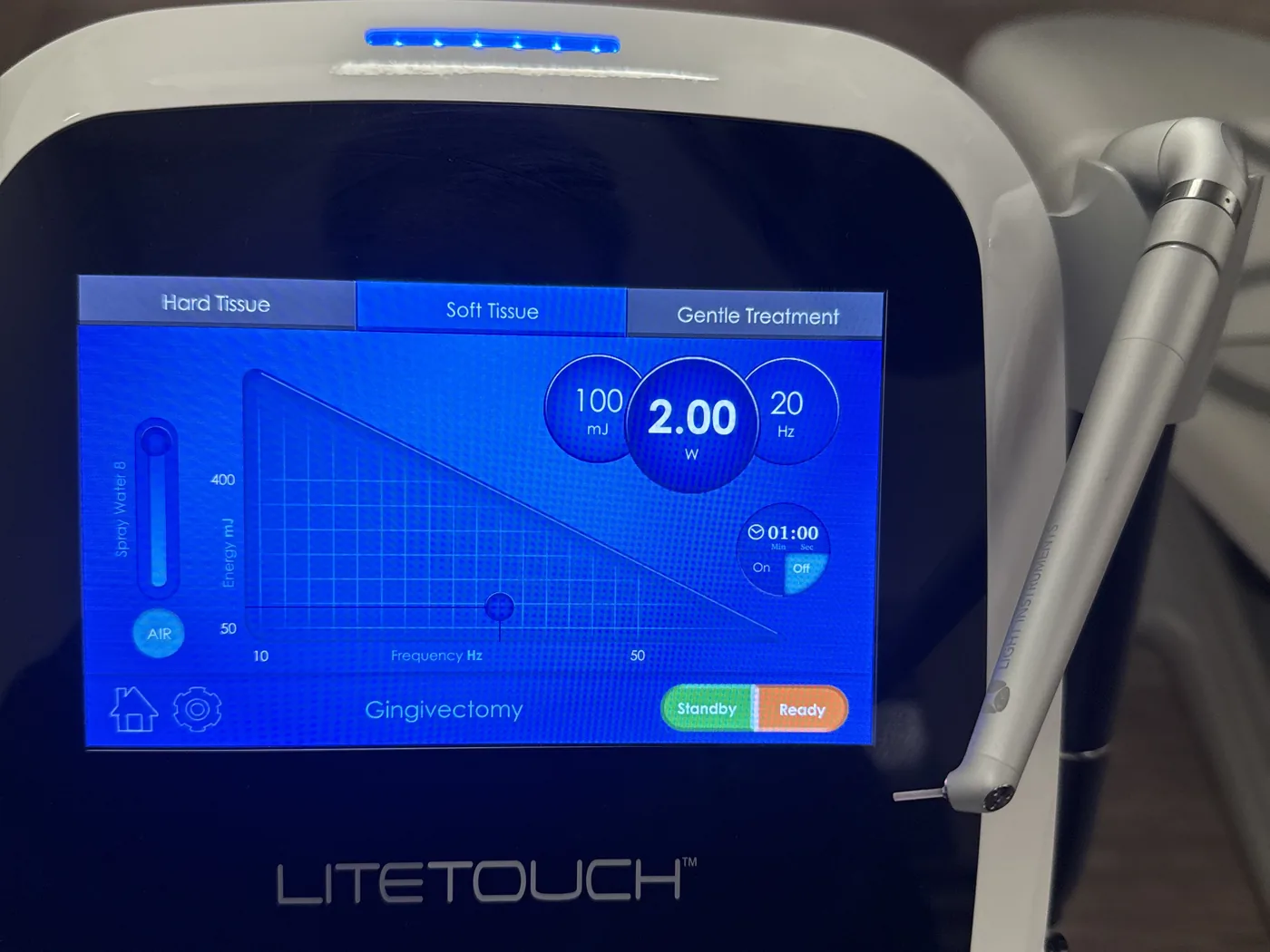
The LiteTouch control panel. Hard tissue and soft tissue programs run on the same unit, and the laser source sits inside the handpiece rather than in the console.
Dr. Mercado is trained on the LiteTouch system. If you want to know more about how it will apply to your specific tooth, the fastest answer is a look and a conversation.
PATIENT QUESTIONS
Laser dentistry FAQ
Can I really get a filling without a shot?
Often, yes. Because the Er:YAG laser removes decay with pulses of energy rather than friction, it produces no heat pressure and no vibration, which are the two things that make a conventional handpiece uncomfortable. Many patients have small and moderate cavities treated with no injection at all. It is not a guarantee. Deep decay close to the nerve, teeth that are already inflamed, and larger restorations may still call for local anesthetic. Dr. Mercado starts without it whenever the case allows, checks in as he works, and numbs you the moment you want it.
Does the laser hurt?
Most patients describe a light tapping sensation with a cool water spray, and a popping sound rather than a whine. There is no vibration and no pressure against the tooth. Sensitivity varies from person to person and from tooth to tooth, so the honest answer is that comfort is high for most people and anesthetic remains available at any point, for any reason, no explanation needed.
What laser do you use?
The LiteTouch Er:YAG dental laser, made by Light Instruments. It runs at a 2,940 nanometer wavelength and is cleared by the FDA for hard tissue work such as caries removal and cavity preparation, and for soft tissue work such as gingivectomy and frenectomy. Dr. Mercado is trained on the LiteTouch system.
Is laser dentistry safe?
Erbium dental lasers have been in clinical use for decades and the LiteTouch system is FDA cleared for the procedures Dr. Mercado performs with it. Everyone in the room wears wavelength-specific protective eyewear, including you. The laser is used at settings matched to the tissue being treated, and a water spray keeps the tooth cool throughout.
Can the laser replace the drill entirely?
No. The laser handles a large share of everyday restorative and soft tissue work, but conventional instruments are still the right tool for removing old metal fillings and crowns, for shaping certain preparations, and for some deeper or harder-to-reach cases. Dr. Mercado chooses the instrument that fits the tooth in front of him.
Is laser treatment more expensive?
A laser filling is quoted the same way any other restoration is quoted, based on the tooth, the surfaces involved, and the material. Dr. Mercado reviews the plan and the exact figures with you before anything begins, and nothing is started without your agreement.
Does insurance cover laser dentistry?
Insurance pays on the procedure, not the instrument. A composite filling is billed as a composite filling whether it was prepared with a laser or a handpiece, so coverage is generally unaffected. The front office verifies your benefits before treatment and gives you the numbers in writing.
I have severe dental anxiety. Would the laser help me?
It helps many anxious patients for a specific reason: it removes the two triggers people name most, the needle and the sound of the drill. If the injection is what keeps you away, starting with a small laser filling is a low-stakes way to find out whether dentistry can feel different for you. Nitrous oxide is available alongside it, and appointments are scheduled so nothing is rushed.
The information on this page is general dental education, not a diagnosis. Whether laser treatment is appropriate for a given tooth is determined by examination. Individual results and comfort vary.