

LASER FILLINGS IN SACRAMENTO
Need a filling? You may not need the shot.
Dread the needle? Mercado Dental Studio treats many cavities with an Er:YAG dental laser, no drill and often no injection. Call (916) 448-5458.
Signs this page is for you
This page is for you if any of this sounds familiar:
- You have a cavity to fix and the injection is the part you dread
- The sound of the drill bothers you more than anything else
- You hate being numb for hours after a short appointment
- You have put off a small filling long enough that it is no longer small
- Numbing has never worked reliably on you
NO DRILL. NO VIBRATION. OFTEN NO NEEDLE.
The needle and the drill are the reasons people wait. Both are avoidable more often than you think.
Almost nobody is actually afraid of a cavity. What people avoid is the injection in the roof of the mouth, the whine of the handpiece, and the hour of a numb, useless lip afterward. Those three things have kept a lot of small cavities from being fixed while they were still small.
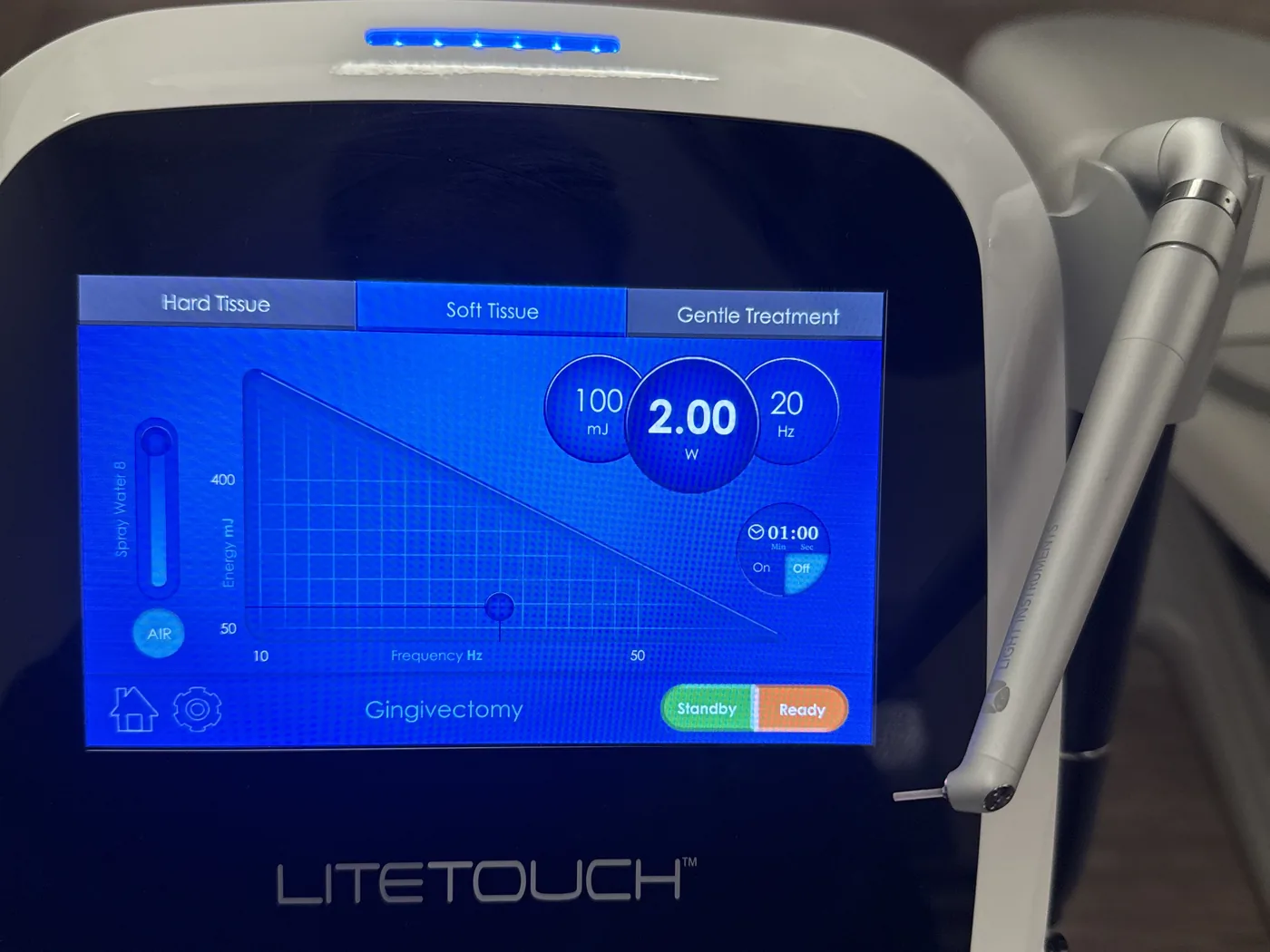
Mercado Dental Studio uses the LiteTouch Er:YAG dental laser, which removes decay with pulses of light energy absorbed by the water inside the tooth. There is no spinning bur, so there is no friction, no heat pressure, and no vibration reaching the nerve. Those are the inputs anesthetic exists to block. Without them, a great many patients complete a filling with no injection at all and leave with full feeling in their face.
WAYS TO FIX IT
Treatment paths we may recommend
The right option depends on your exam. These are the treatments Dr. Mercado draws on for this concern, from most conservative to most comprehensive.
Most conservative
Er:YAG Laser Filling
Decay removed with pulsed laser energy instead of a spinning bur. No vibration, no heat pressure, and for many patients no injection at all.
The restoration
Tooth-Colored Composite
The restoration itself. Bonded composite, shade-matched by hand, sculpted to your bite and polished so it disappears into the tooth.
Minimal preparation
BioClear
For gaps, black triangles, and worn edges where a traditional filling would mean cutting away healthy tooth. Injection-molded composite, minimal preparation.
If nerves are the issue
Nitrous Oxide
If nerves rather than sensation are the real obstacle, nitrous can run alongside laser treatment. Adjustable, and it clears within minutes of finishing.
Why numbing is often unnecessary with a laser
The nerve inside a tooth is not especially bothered by the idea of decay being removed. It reacts to two specific things a rotary handpiece produces: frictional heat and mechanical vibration. That is what triggers the sharp response most people associate with the drill, and it is why anesthetic became routine.
An Er:YAG laser at 2,940 nanometers works differently. The wavelength is absorbed almost entirely by water. Each pulse energizes the water inside a microscopically thin layer of tooth structure, which lifts that layer away, while a cooling water spray runs continuously across the surface. Nothing touches the tooth. Nothing spins. Nothing heats up under pressure.
There is a second effect worth knowing. Decayed tooth structure holds far more water than healthy, mineralized enamel does, so the laser is naturally more aggressive toward decay than toward the tooth you want to keep. That is why laser preparation tends to be more conservative than a bur, and it is the core idea behind minimally invasive dentistry.
What actually happens at the appointment
Dr. Mercado looks at the tooth and the radiographs and tells you straight whether he expects the laser to handle it comfortably. If yes, you both put on protective eyewear and he begins without anesthetic. After a few seconds he asks how it feels. If you are comfortable, the filling proceeds that way. If you are not, you are numbed immediately and the visit continues normally. Nobody is asked to be brave.
Once decay is removed, the rest of the appointment is a standard composite restoration: bond, layer, cure, shape to your bite, polish. The filling is the same filling. Only the preparation changed.
Being straight about the limits
The laser does not replace every instrument. It does not cut metal, so old amalgam and metal crowns come out conventionally. Very deep decay approaching the nerve, teeth already inflamed and sensitized, and certain crown preparations are still better served by anesthetic and a handpiece. Some surfaces between back molars are simply easier to reach with a bur.
Comfort also varies. Most patients find laser preparation easy. A minority prefer to be numb regardless, and that is a completely reasonable choice that will be honored without a discussion.
If it has been a while
A lot of people reading this have been avoiding a filling for years, and the avoidance has usually made the list longer rather than shorter. If that is you, the useful thing to know is that the first appointment can be nothing more than a look and an honest conversation. Anxious patients often start with one small laser filling specifically because it is a low-stakes way to find out whether dentistry can feel different than it did the last time.
You can read more about the technology on the laser dentistry page, or call the studio and ask whether your tooth is a candidate.
PATIENT QUESTIONS
Cavities FAQ
Can you really do a filling without numbing me?
In many cases, yes. The Er:YAG laser removes decay with pulses of energy rather than friction, which means there is no vibration and no heat pressure traveling into the nerve. Those are the two sensations local anesthetic is mostly there to block. Dr. Mercado starts without the injection whenever the case allows, checks with you after the first few seconds, and numbs you the moment you ask. Deeper decay, an already inflamed tooth, or a large restoration can still call for anesthetic, and that is a clinical judgment made tooth by tooth.
What does a laser filling feel like?
Most patients describe a rhythmic tapping or popping sound and a cool water mist on the tooth. There is no whine, no vibration, and nothing pressing against the tooth. Some people feel a brief warm or tingling sensation on a particular spot, which is usually the cue to slow down or adjust the settings. Sensitivity varies from person to person, so the arrangement is simple: raise a hand and everything stops.
Is a laser filling as strong as a normal filling?
The filling material is identical. What changes is how the decay was removed and how the tooth was prepared. The restoration is still bonded tooth-colored composite, layered, cured, shaped to your bite, and polished exactly as it would be after conventional preparation. Laser preparation also tends to leave a cleaner surface without the smear layer a bur creates, which is favorable for bonding.
Does the laser work on every cavity?
No. The laser is well suited to small and moderate decay in enamel and dentin. It does not cut metal, so old amalgam fillings and metal crowns are removed conventionally. Very deep decay near the nerve, some full-coverage crown preparations, and certain hard-to-reach surfaces between back teeth are often handled better with a handpiece. Dr. Mercado tells you which category your tooth falls into before he starts, not after.
How long does it take?
A single laser filling is generally a one-visit appointment. Laser preparation can run somewhat longer than a bur on a larger restoration, and most patients consider that a fair trade for skipping the injection and walking out with normal sensation. If you are short on time and would rather move quickly, say so and the plan adjusts.
Can I eat afterward?
If you were not numbed, yes, right away. That is one of the underrated advantages. There is no numb lip to bite, no slurred hour, and no waiting through lunch. Mild sensitivity to cold for a day or two is normal after any new filling, laser or not.
Is it more expensive than a regular filling?
A filling is quoted on the tooth, the number of surfaces, and the material, the same way it always has been. Insurance pays on the procedure rather than the instrument, so a composite filling is billed as a composite filling either way. The front office verifies your benefits and gives you the figures before treatment begins.
SACRAMENTO CONSULTATIONS
Let's look at it together.
1029 56th Street, Sacramento, CA 95819 Mon–Thu 7AM–4PM Fri 8AM–12PM
The information on this page is general dental education, not a diagnosis. An exam is required before any treatment recommendation.